Skip to content
CuriousDevs

OJAS

The model proposes.
OJAS decides and acts.

OJAS turns AI output into controlled action on a real machine. It perceives, keeps a live picture of the scene, plans the next step, checks it against your rules, and carries it out — continuously, at the edge.
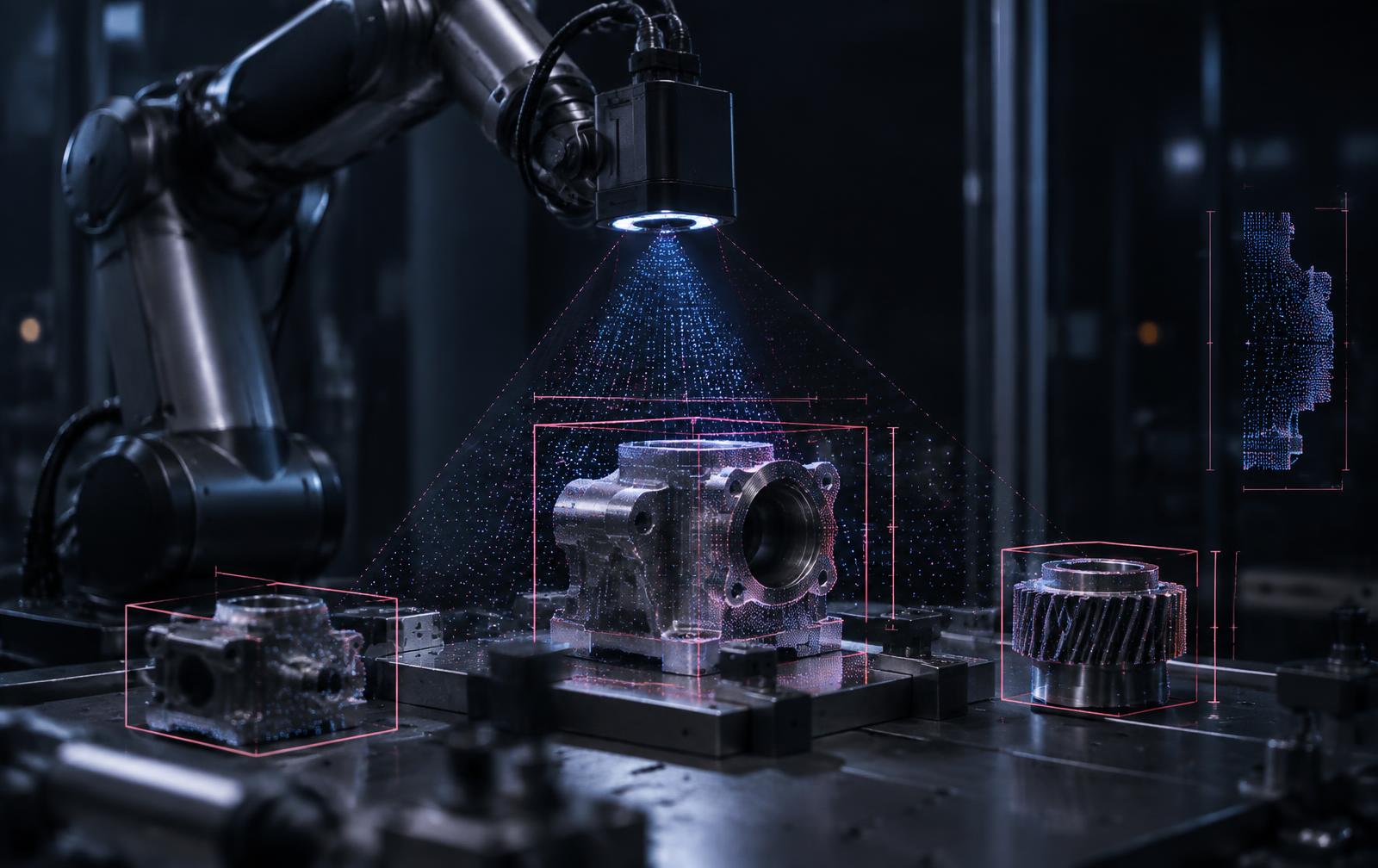
A robotic arm scanning metal parts on a workbench, each part outlined with a detection box and measurement lines
SENSOR STREAMS BECOME STRUCTURED OBSERVATION

What you get

Four things a trained model does not give you.

01

Works with any model

A CuriousDevs model, a third-party model or your own — all behind one contract, on the edge compute you already have.

02

Nothing moves without permission

Every action passes a rule check with no machine learning inside it. What you forbid stays forbidden, even when the model is wrong.

03

You can see what it did

Every cycle is recorded: what was seen, what was proposed, what was allowed, and what happened.

04

One package to deploy

Model, rules, tools, actions and configuration ship as one versioned unit, so you reproduce a deployment instead of rebuilding it.

How it works

A trained model answers once. OJAS keeps going.

Each cycle reads the world, updates state, runs the model, plans, checks policy and acts — then observes the result and starts again. Select a stage to see what it owns.

Closed loop · continuous

THE LAST STAGE FEEDS THE FIRST — THE LOOP DOES NOT END

Authority

Policy check

Rules and policies, permissions and forbidden actions are evaluated against the proposal and the world state. A proposal that fails any check is refused and recorded. This layer contains no machine learning.

A trained model is not a Physical AI system. Acting in the physical world means combining model output with live sensing, current world state, explicit rules and a controlled way to operate real devices — continuously, on constrained edge hardware.

Where it sits

One layer, with clear contracts above and below.

Models supply intelligence. Edge compute supplies capacity. Sensors and actuators supply the physical world. OJAS owns the path between them.

Model interface, intelligence execution layer and runtime services. Perception, world state, reasoning, planning, memory, rules and policies, tools and actions, safety and permissions, telemetry and device abstraction.

Ownership

CuriousDevs Intelligence

INTENT FLOWS DOWN · STATE FLOWS UP · OJAS RUNTIME OWNS THE MODEL-TO-ACTION PATH

Authority

What goes wrong, and what stops it.

A model returns a proposal. It has no idea what is legal or safe right now, so the layer around it decides — and there is no machine learning inside that decision.

Failure classes designed against

In the numbers

A smooth, plausible action toward the wrong outcome

If unhandled

A wrong result that nothing in the numbers flags

Caught by

Outcome recording and failure classification

A model emits numbers, not intentions. It carries no notion of what is legal, safe or currently possible — so everything that decides whether an action may execute has to live outside the model. These are the classes OJAS is designed against.

Rejected before it reaches the motors

  • Contract validity

    Output that does not match the model's declared output contract

  • Numerical validity

    Non-finite values and values outside any physical range

  • Authorisation

    Actions the deployment's policy does not permit

  • Forbidden actions

    Explicitly prohibited behaviour, regardless of confidence

  • Task and environment constraints

    Actions valid in general but not in this workcell or this task

  • Staleness

    Intent computed from observations older than the loop allows

Boundaries

What OJAS is not.

Not only a model

OJAS is the execution system first, and it stays model-agnostic. A CuriousDevs model, a third-party model or your own runs behind the same contract, chosen to suit the deployment rather than required by it.

Not general-purpose autonomy

A human defines the task, the workcell and the rules. OJAS executes inside them.

Not a safety certification

Policy checking reduces risk. It is not compliance with any standard and never replaces independent safety hardware.

FIGURES ON THIS SITE ARE ENGINEERING TARGETS WITH STATED METHODS · PUBLISHED AS RESULTS ONLY ONCE MEASURED

Getting started

How an engagement begins.

  • You describe one station: the machine, the task, and what happens today when it fails.
  • We agree on what success means and how it will be measured.
  • We bring one loop up end to end on your hardware, and record how it behaves.
  • Only then do we widen to more objects, more stations or more machines.